Northstead
A premium HVAC brand serving homes and commercial buildings across Boise and the Treasure Valley.
Industry: Heating & Cooling
Engagement: Pre-launch through launch — ongoing as governance
Role: Brand architect → Periodic contract designer/director
Scope: Positioning · Visual identity · Verbal identity · Brand governance · Website
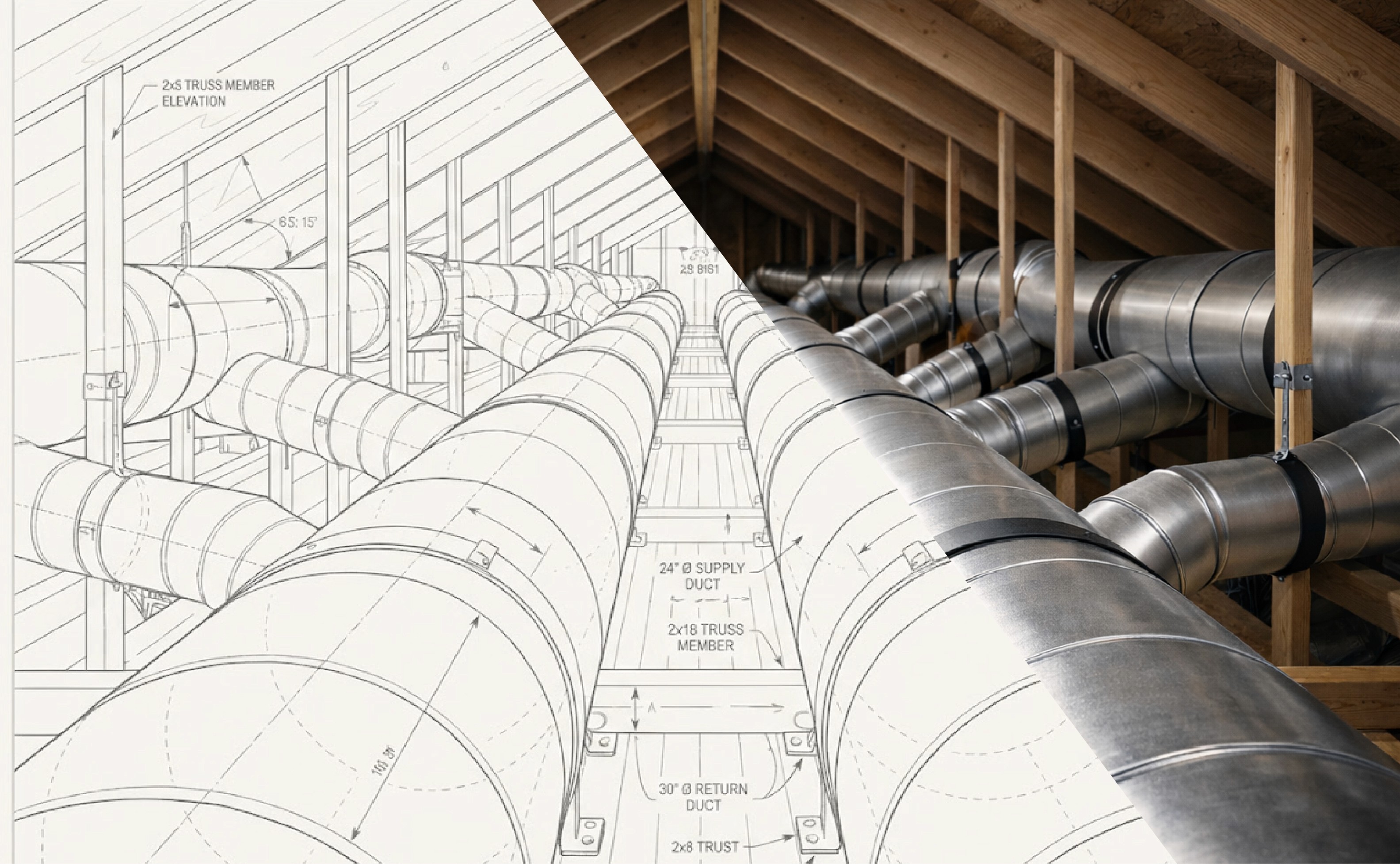
Northstead came up the way most service brands do: a capable operator, a real business, and a category that rewards noise. HVAC sells on urgency and replacement — fastest, cheapest, your unit's dead, buy a new one today. Loud trucks. Discount events. Emergency theater.
That was the lane Northstead was being measured against, and it was the wrong lane. The company's actual work — evaluating why a system underperforms, correcting it, and standing behind it over years — is the opposite of a panic sale. The brand had to make that difference legible before a single ad ran.
The Diagnosis
The problem wasn't a logo. It was a category posture.
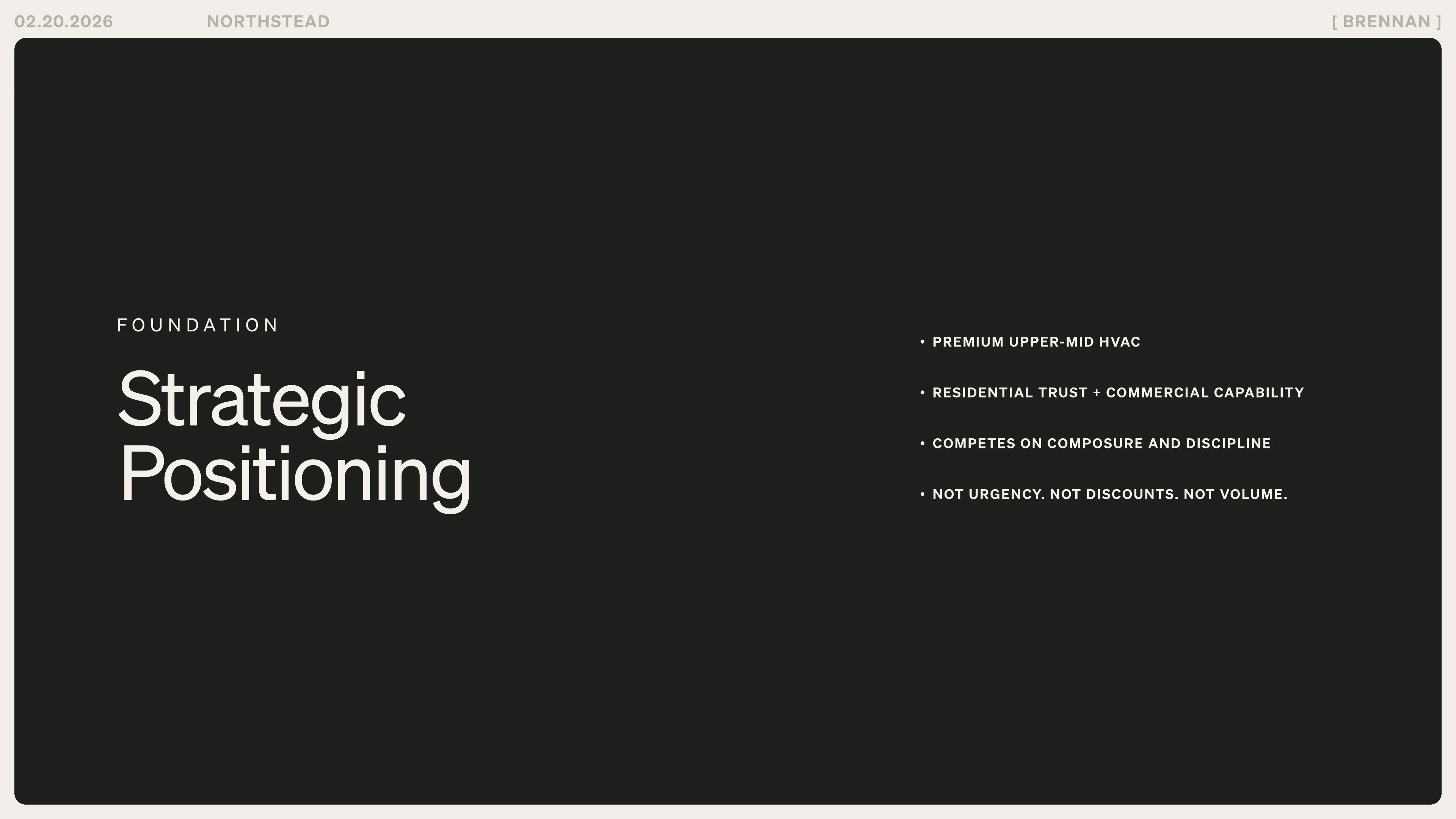
Northstead serves custom homes in prominent neighborhoods and commercial clients who don't respond to urgency — they respond to competence held over time. Competing on the category's terms (speed, price, volume) would have priced the company into a race it didn't want and couldn't win on margin. The real position was the inverse of everything the category sells: performance over replacement, composure over urgency, documentation over drama.
That's a sharp position. It's also a fragile one. A brand that wins by refusing the easy moves will drift back toward them the first slow month — the first "limited-time" email, the first 50/50 sale banner, the first red-and-blue truck wrap. So the work wasn't only to define the position. It was to build something that could hold it after handoff. Predictability is premium — but only if the brand stays disciplined enough to stay predictable.

The Build
The System
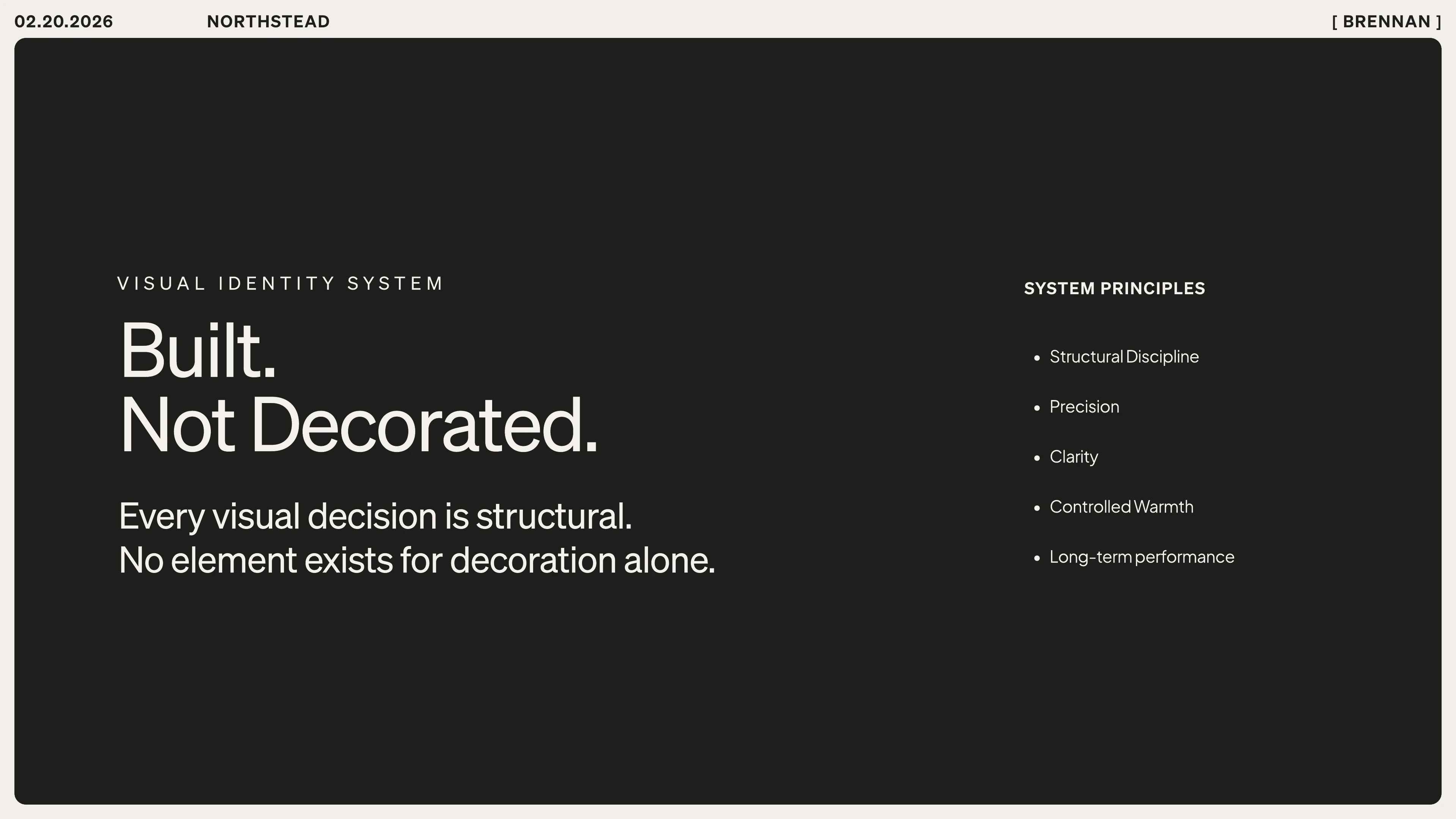
The visual identity is engineered, not decorated. A single master angle — −53.25° — governs layout, pattern, and structural accents; the only supporting angles permitted are 0° and 90°. One angle, everywhere, is not a style choice. It's discipline a client can see.
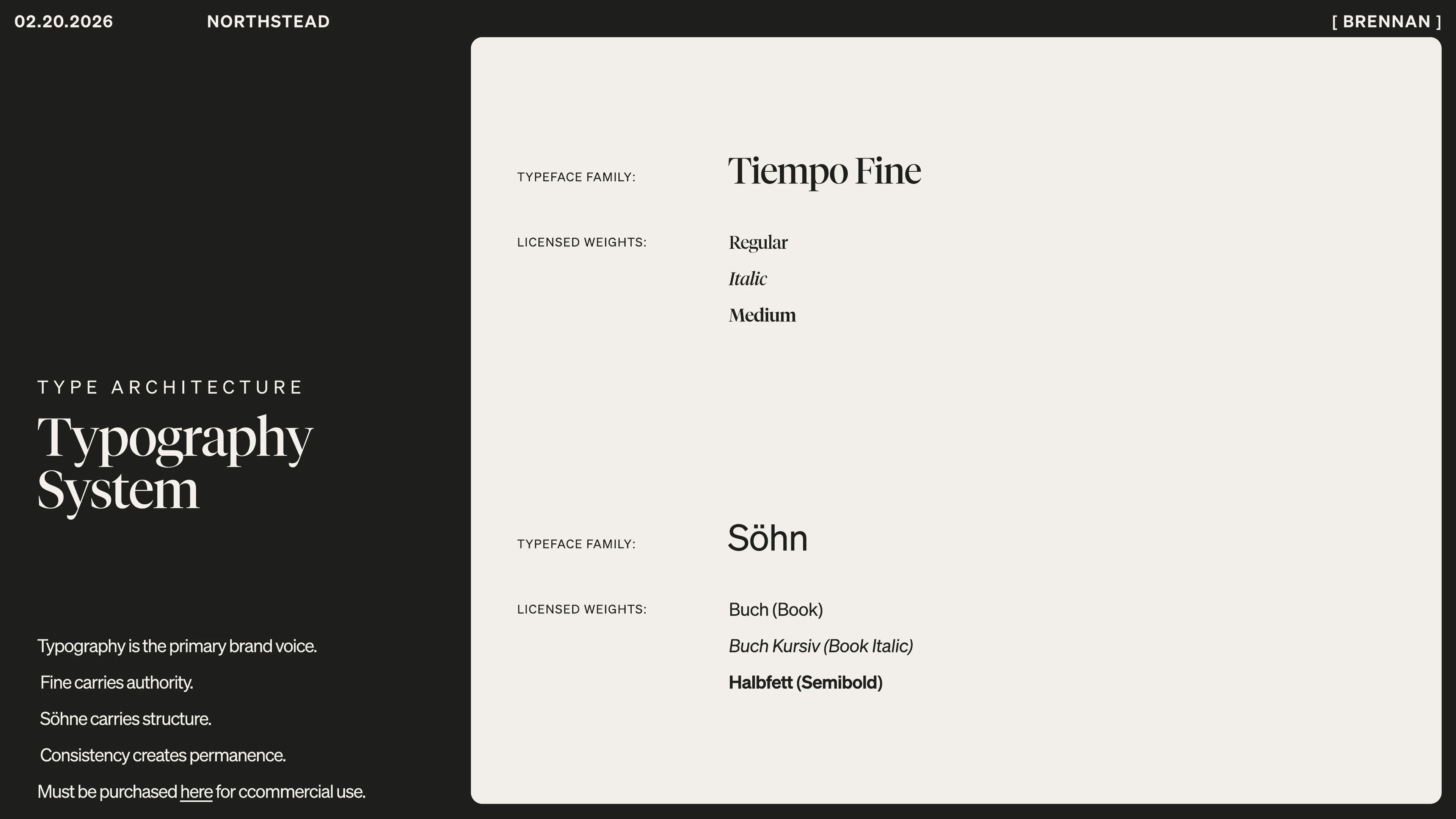
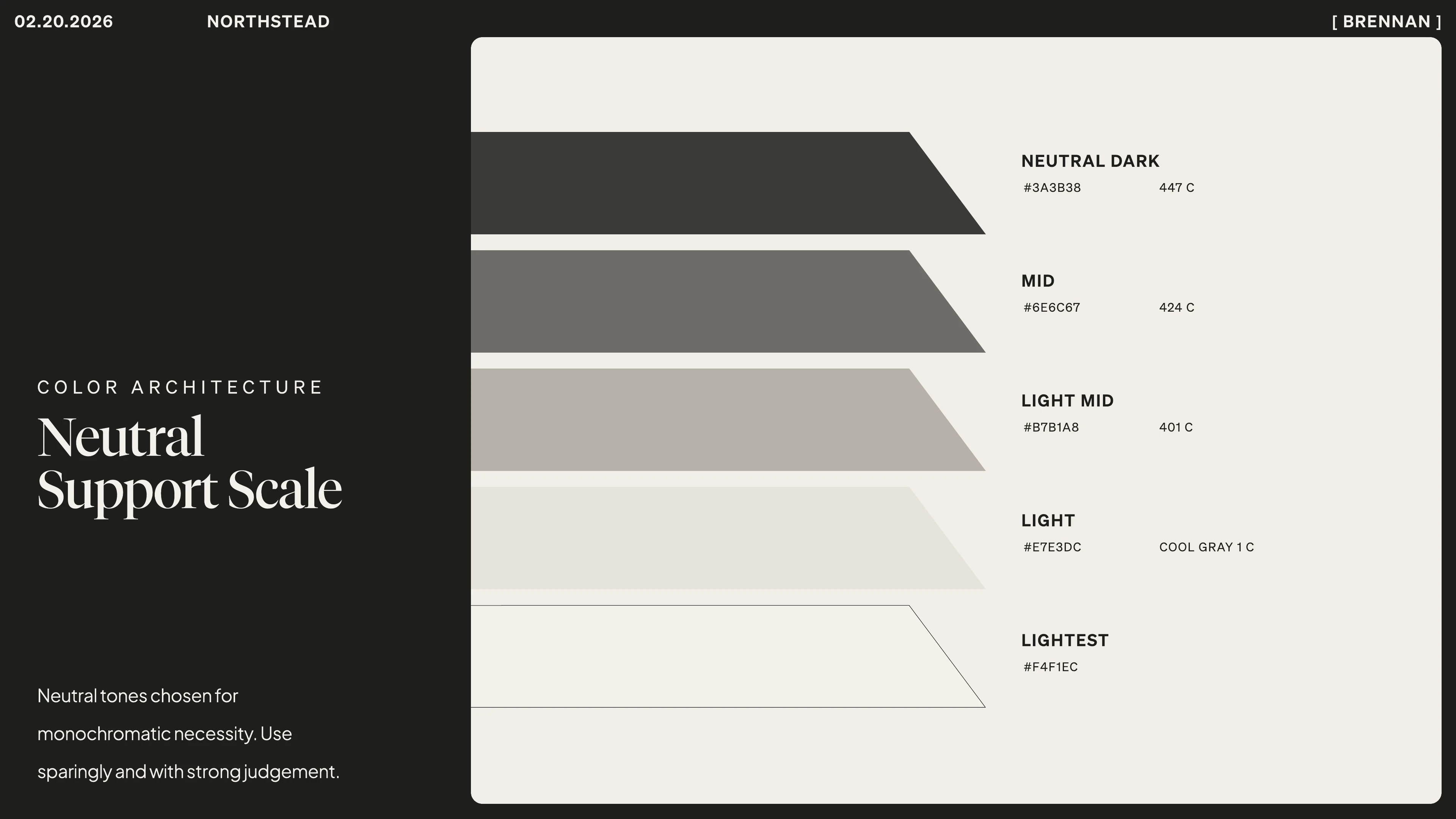
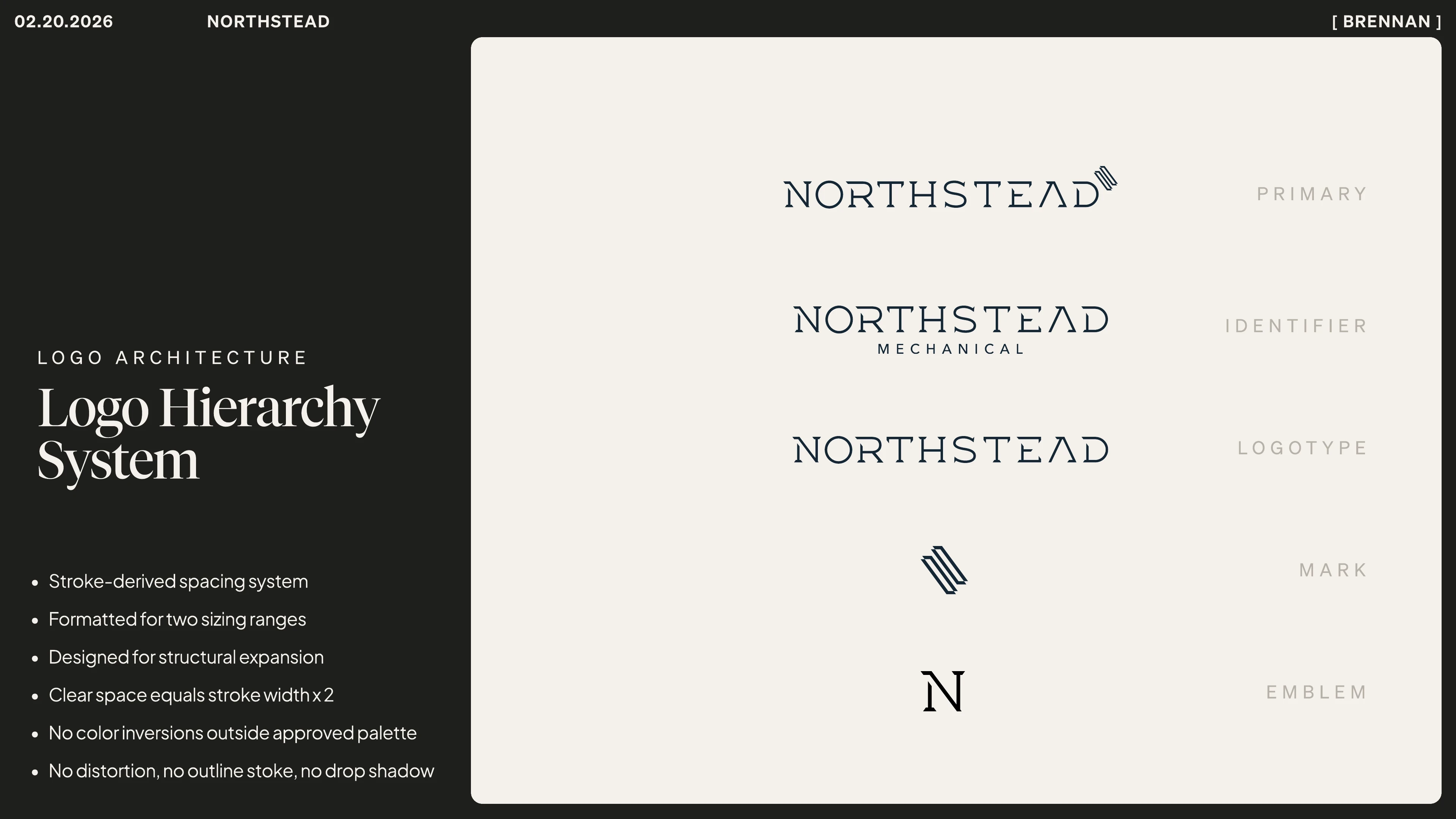
The color architecture deliberately refuses the category's defaults — no fire-and-ice red and blue. It's built on deep warm charcoal, warm ivory, and structural taupes, with a single terracotta accent for confident differentiation, capped so it can never take over a layout. A dual-type system splits the labor: Tiempo Fine carries authority in headlines, Söhne carries mechanical clarity everywhere else. The logo runs as a hierarchy — primary, identifier, logotype, mark, emblem — on stroke-derived spacing, formatted to hold from a fleet van down to embroidery. Every graphic element is derived from the logo geometry itself. Nothing is introduced for decoration.
The Voice
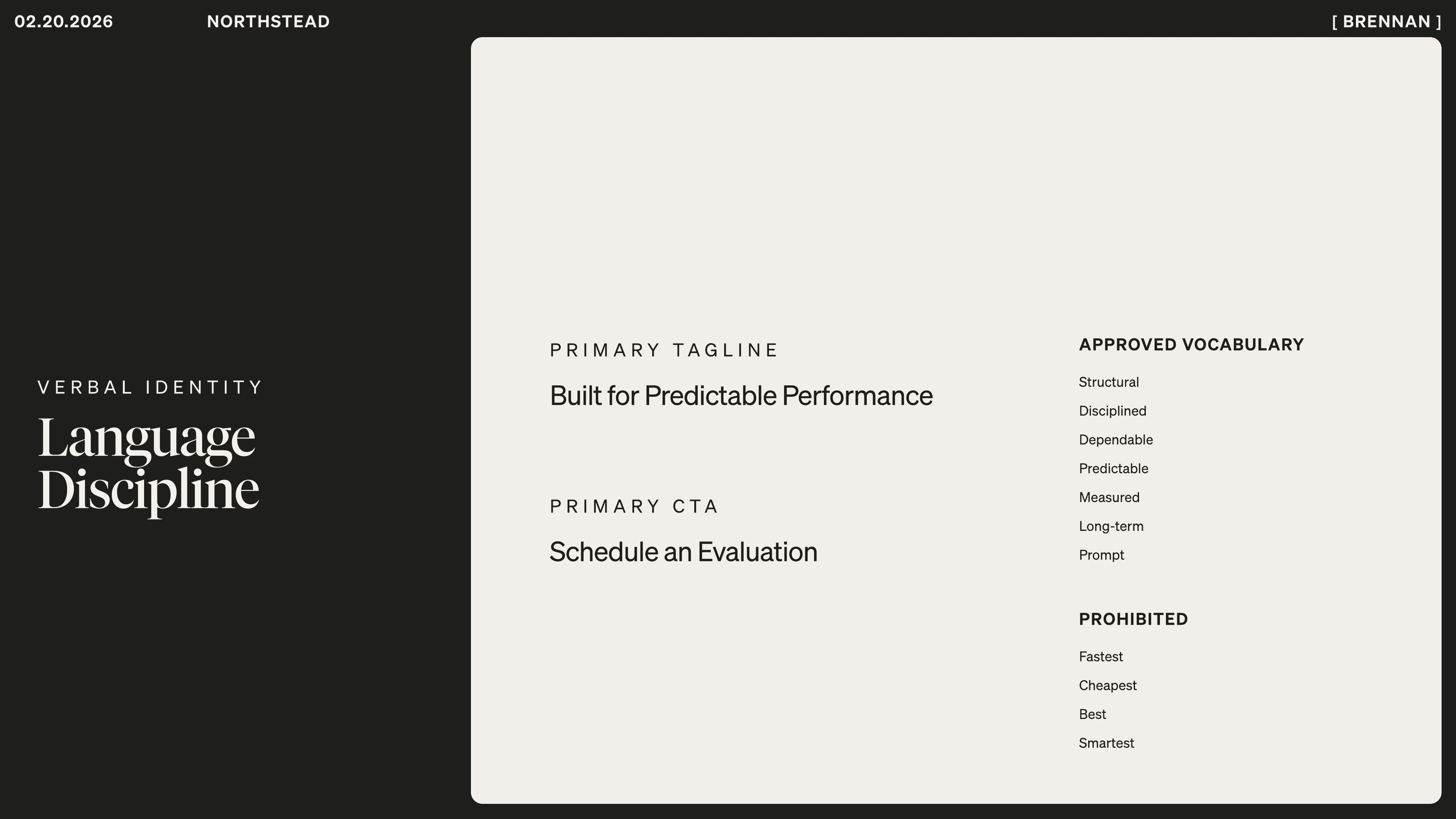
Northstead sounds the way it works: controlled warmth, institutional composure. Calm, structured, measured, intentional — never promotional, urgent, emotional, or theatrical. The language system is enforced, not suggested: an approved vocabulary (structural, disciplined, engineered, measured, predictable, stewardship) and a prohibited one (fastest, cheapest, best, call now, limited time, emergency theatrics). If it sounds like advertising, it comes out.
The tagline states the whole strategy in three words: Built for Predictable Performance. The primary call to action refuses the category reflex — Schedule a Structured Evaluation, not "Call Now." Four messaging pillars — Structural Reliability, Precision Service, Professional Conduct, Mechanical Intelligence — carry consistently from a sales proposal to a maintenance agreement. And trust is built in a fixed order: structural philosophy, then execution discipline, then operational transparency, then long-term stewardship. The order doesn't reverse.
The Governance
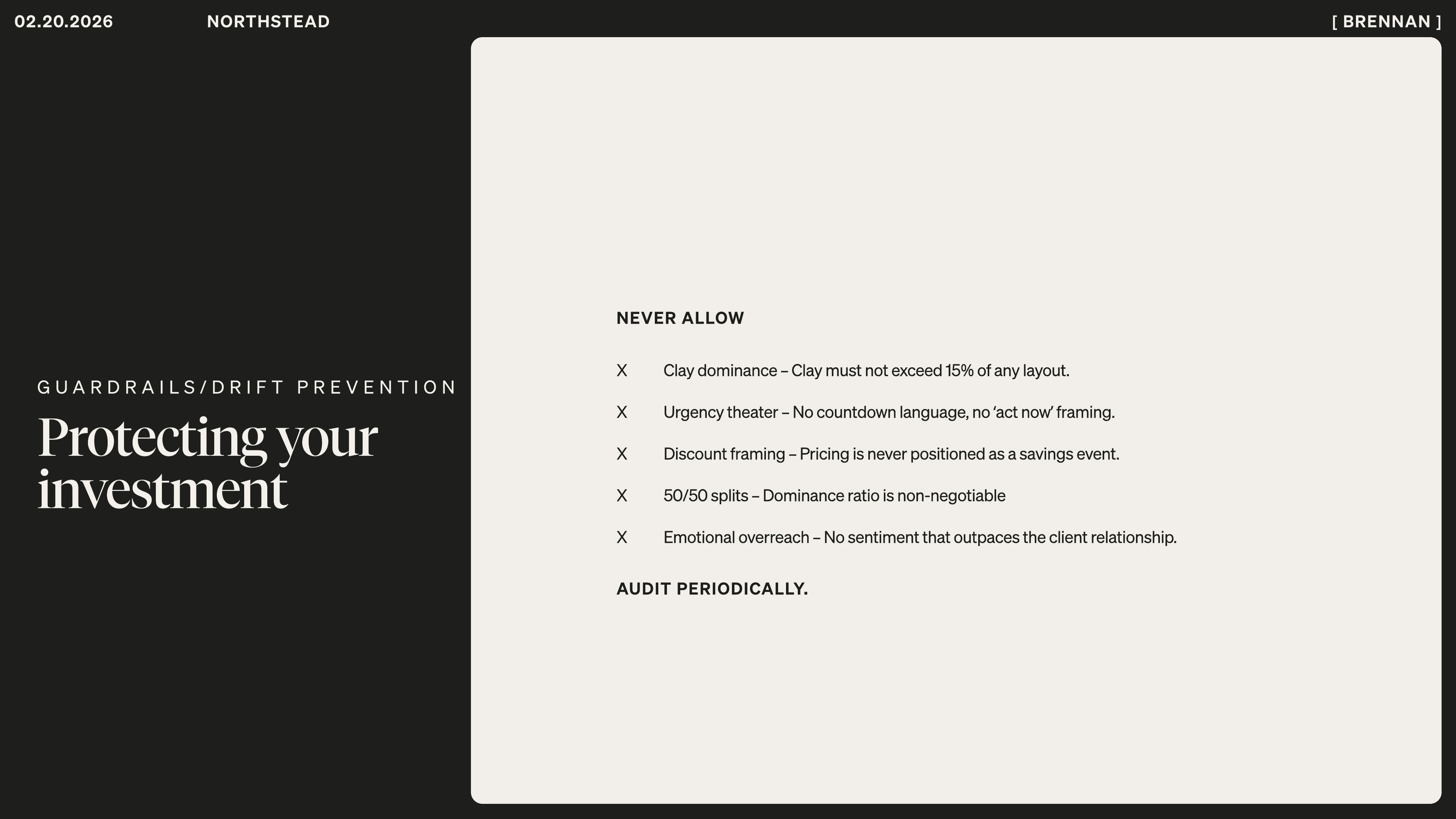
This is the layer most brands never get, and the reason Northstead is worth studying. The system was documented to survive its own growth. Channel translation rules define how the identity behaves across website, sales materials, email, advertising, and maintenance plans. Hard guardrails set the limits the brand will protect under pressure: terracotta never exceeds 15% of a layout, no 50/50 splits, no urgency framing, no discount positioning. A quarterly drift audit checks for the exact failure modes a premium brand slides into — over-friendliness, price competition, emotional overreach — and corrects them on a schedule.
The brand was engineered to police itself. That is the deliverable.
The Handoff
The governance system is the handoff. Northstead doesn't need the person who built it to stay disciplined — the rules are written down, the limits are explicit, and the audit is something the founder can run alone. The legal spine is in place: Northstead operates as a trade name of Spruce & Vine LLC under Idaho HVAC Contractor License #1471594. The site is live. The brand can scale without dilution and adapt without drift, because the conditions for both were defined before launch.
Built to be removed. The clearest version of the whole idea.
What's True Now
Northstead is live, competing on the one thing its category doesn't sell: predictability. The homepage leads with the position, not a pitch — performance, not replacement — and the disciplines underneath it read as evaluation, optimization, and predictive maintenance rather than rip-and-replace.
The strongest proof isn't in the brand book. It's in how clients already describe the company: that it didn't push a new unit, that it made smaller adjustments to extend the system and hold costs down, that the work was thorough and explained plainly. The positioning isn't a claim the brand is making about itself — it's the thing customers are independently saying back. That's what a brand is supposed to do, and it's what this one was built to keep doing long after the handoff.

More Work

[ LET'S TALK ]
If you’re building something that matters, I’d love to hear about it.
[ LET'S TALK ]
If you’re building something that matters, I’d love to hear about it.
Northstead
A premium HVAC brand serving homes and commercial buildings across Boise and the Treasure Valley.
Industry: Heating & Cooling
Engagement: Pre-launch through launch — ongoing as governance
Role: Brand architect → Periodic contract designer/director
Scope: Positioning · Visual identity · Verbal identity · Brand governance · Website
Northstead came up the way most service brands do: a capable operator, a real business, and a category that rewards noise. HVAC sells on urgency and replacement — fastest, cheapest, your unit's dead, buy a new one today. Loud trucks. Discount events. Emergency theater.
That was the lane Northstead was being measured against, and it was the wrong lane. The company's actual work — evaluating why a system underperforms, correcting it, and standing behind it over years — is the opposite of a panic sale. The brand had to make that difference legible before a single ad ran.
The Diagnosis
The problem wasn't a logo. It was a category posture.
Northstead serves custom homes in prominent neighborhoods and commercial clients who don't respond to urgency — they respond to competence held over time. Competing on the category's terms (speed, price, volume) would have priced the company into a race it didn't want and couldn't win on margin. The real position was the inverse of everything the category sells: performance over replacement, composure over urgency, documentation over drama.
That's a sharp position. It's also a fragile one. A brand that wins by refusing the easy moves will drift back toward them the first slow month — the first "limited-time" email, the first 50/50 sale banner, the first red-and-blue truck wrap. So the work wasn't only to define the position. It was to build something that could hold it after handoff. Predictability is premium — but only if the brand stays disciplined enough to stay predictable.
The Build
The System
The visual identity is engineered, not decorated. A single master angle — −53.25° — governs layout, pattern, and structural accents; the only supporting angles permitted are 0° and 90°. One angle, everywhere, is not a style choice. It's discipline a client can see.
The color architecture deliberately refuses the category's defaults — no fire-and-ice red and blue. It's built on deep warm charcoal, warm ivory, and structural taupes, with a single terracotta accent for confident differentiation, capped so it can never take over a layout. A dual-type system splits the labor: Tiempo Fine carries authority in headlines, Söhne carries mechanical clarity everywhere else. The logo runs as a hierarchy — primary, identifier, logotype, mark, emblem — on stroke-derived spacing, formatted to hold from a fleet van down to embroidery. Every graphic element is derived from the logo geometry itself. Nothing is introduced for decoration.
The Voice
Northstead sounds the way it works: controlled warmth, institutional composure. Calm, structured, measured, intentional — never promotional, urgent, emotional, or theatrical. The language system is enforced, not suggested: an approved vocabulary (structural, disciplined, engineered, measured, predictable, stewardship) and a prohibited one (fastest, cheapest, best, call now, limited time, emergency theatrics). If it sounds like advertising, it comes out.
The tagline states the whole strategy in three words: Built for Predictable Performance. The primary call to action refuses the category reflex — Schedule a Structured Evaluation, not "Call Now." Four messaging pillars — Structural Reliability, Precision Service, Professional Conduct, Mechanical Intelligence — carry consistently from a sales proposal to a maintenance agreement. And trust is built in a fixed order: structural philosophy, then execution discipline, then operational transparency, then long-term stewardship. The order doesn't reverse.
The Governance
This is the layer most brands never get, and the reason Northstead is worth studying. The system was documented to survive its own growth. Channel translation rules define how the identity behaves across website, sales materials, email, advertising, and maintenance plans. Hard guardrails set the limits the brand will protect under pressure: terracotta never exceeds 15% of a layout, no 50/50 splits, no urgency framing, no discount positioning. A quarterly drift audit checks for the exact failure modes a premium brand slides into — over-friendliness, price competition, emotional overreach — and corrects them on a schedule.
The brand was engineered to police itself. That is the deliverable.
The Handoff
The governance system is the handoff. Northstead doesn't need the person who built it to stay disciplined — the rules are written down, the limits are explicit, and the audit is something the founder can run alone. The legal spine is in place: Northstead operates as a trade name of Spruce & Vine LLC under Idaho HVAC Contractor License #1471594. The site is live. The brand can scale without dilution and adapt without drift, because the conditions for both were defined before launch.
Built to be removed. The clearest version of the whole idea.
What's True Now
Northstead is live, competing on the one thing its category doesn't sell: predictability. The homepage leads with the position, not a pitch — performance, not replacement — and the disciplines underneath it read as evaluation, optimization, and predictive maintenance rather than rip-and-replace.
The strongest proof isn't in the brand book. It's in how clients already describe the company: that it didn't push a new unit, that it made smaller adjustments to extend the system and hold costs down, that the work was thorough and explained plainly. The positioning isn't a claim the brand is making about itself — it's the thing customers are independently saying back. That's what a brand is supposed to do, and it's what this one was built to keep doing long after the handoff.
More Work
[ LET'S TALK ]
If you’re building something that matters, I’d love to hear about it.
Northstead
A premium HVAC brand serving homes and commercial buildings across Boise and the Treasure Valley.
Industry: Heating & Cooling
Engagement: Pre-launch through launch — ongoing as governance
Role: Brand architect → Periodic contract designer/director
Scope: Positioning · Visual identity · Verbal identity · Brand governance · Website
Northstead came up the way most service brands do: a capable operator, a real business, and a category that rewards noise. HVAC sells on urgency and replacement — fastest, cheapest, your unit's dead, buy a new one today. Loud trucks. Discount events. Emergency theater.
That was the lane Northstead was being measured against, and it was the wrong lane. The company's actual work — evaluating why a system underperforms, correcting it, and standing behind it over years — is the opposite of a panic sale. The brand had to make that difference legible before a single ad ran.
The Diagnosis
The problem wasn't a logo. It was a category posture.
Northstead serves custom homes in prominent neighborhoods and commercial clients who don't respond to urgency — they respond to competence held over time. Competing on the category's terms (speed, price, volume) would have priced the company into a race it didn't want and couldn't win on margin. The real position was the inverse of everything the category sells: performance over replacement, composure over urgency, documentation over drama.
That's a sharp position. It's also a fragile one. A brand that wins by refusing the easy moves will drift back toward them the first slow month — the first "limited-time" email, the first 50/50 sale banner, the first red-and-blue truck wrap. So the work wasn't only to define the position. It was to build something that could hold it after handoff. Predictability is premium — but only if the brand stays disciplined enough to stay predictable.
The Build
The System
The visual identity is engineered, not decorated. A single master angle — −53.25° — governs layout, pattern, and structural accents; the only supporting angles permitted are 0° and 90°. One angle, everywhere, is not a style choice. It's discipline a client can see.
The color architecture deliberately refuses the category's defaults — no fire-and-ice red and blue. It's built on deep warm charcoal, warm ivory, and structural taupes, with a single terracotta accent for confident differentiation, capped so it can never take over a layout. A dual-type system splits the labor: Tiempo Fine carries authority in headlines, Söhne carries mechanical clarity everywhere else. The logo runs as a hierarchy — primary, identifier, logotype, mark, emblem — on stroke-derived spacing, formatted to hold from a fleet van down to embroidery. Every graphic element is derived from the logo geometry itself. Nothing is introduced for decoration.
The Voice
Northstead sounds the way it works: controlled warmth, institutional composure. Calm, structured, measured, intentional — never promotional, urgent, emotional, or theatrical. The language system is enforced, not suggested: an approved vocabulary (structural, disciplined, engineered, measured, predictable, stewardship) and a prohibited one (fastest, cheapest, best, call now, limited time, emergency theatrics). If it sounds like advertising, it comes out.
The tagline states the whole strategy in three words: Built for Predictable Performance. The primary call to action refuses the category reflex — Schedule a Structured Evaluation, not "Call Now." Four messaging pillars — Structural Reliability, Precision Service, Professional Conduct, Mechanical Intelligence — carry consistently from a sales proposal to a maintenance agreement. And trust is built in a fixed order: structural philosophy, then execution discipline, then operational transparency, then long-term stewardship. The order doesn't reverse.
The Governance
This is the layer most brands never get, and the reason Northstead is worth studying. The system was documented to survive its own growth. Channel translation rules define how the identity behaves across website, sales materials, email, advertising, and maintenance plans. Hard guardrails set the limits the brand will protect under pressure: terracotta never exceeds 15% of a layout, no 50/50 splits, no urgency framing, no discount positioning. A quarterly drift audit checks for the exact failure modes a premium brand slides into — over-friendliness, price competition, emotional overreach — and corrects them on a schedule.
The brand was engineered to police itself. That is the deliverable.
The Handoff
The governance system is the handoff. Northstead doesn't need the person who built it to stay disciplined — the rules are written down, the limits are explicit, and the audit is something the founder can run alone. The legal spine is in place: Northstead operates as a trade name of Spruce & Vine LLC under Idaho HVAC Contractor License #1471594. The site is live. The brand can scale without dilution and adapt without drift, because the conditions for both were defined before launch.
Built to be removed. The clearest version of the whole idea.
What's True Now
Northstead is live, competing on the one thing its category doesn't sell: predictability. The homepage leads with the position, not a pitch — performance, not replacement — and the disciplines underneath it read as evaluation, optimization, and predictive maintenance rather than rip-and-replace.
The strongest proof isn't in the brand book. It's in how clients already describe the company: that it didn't push a new unit, that it made smaller adjustments to extend the system and hold costs down, that the work was thorough and explained plainly. The positioning isn't a claim the brand is making about itself — it's the thing customers are independently saying back. That's what a brand is supposed to do, and it's what this one was built to keep doing long after the handoff.
More Work
[ LET'S TALK ]
If you’re building something that matters, I’d love to hear about it.